
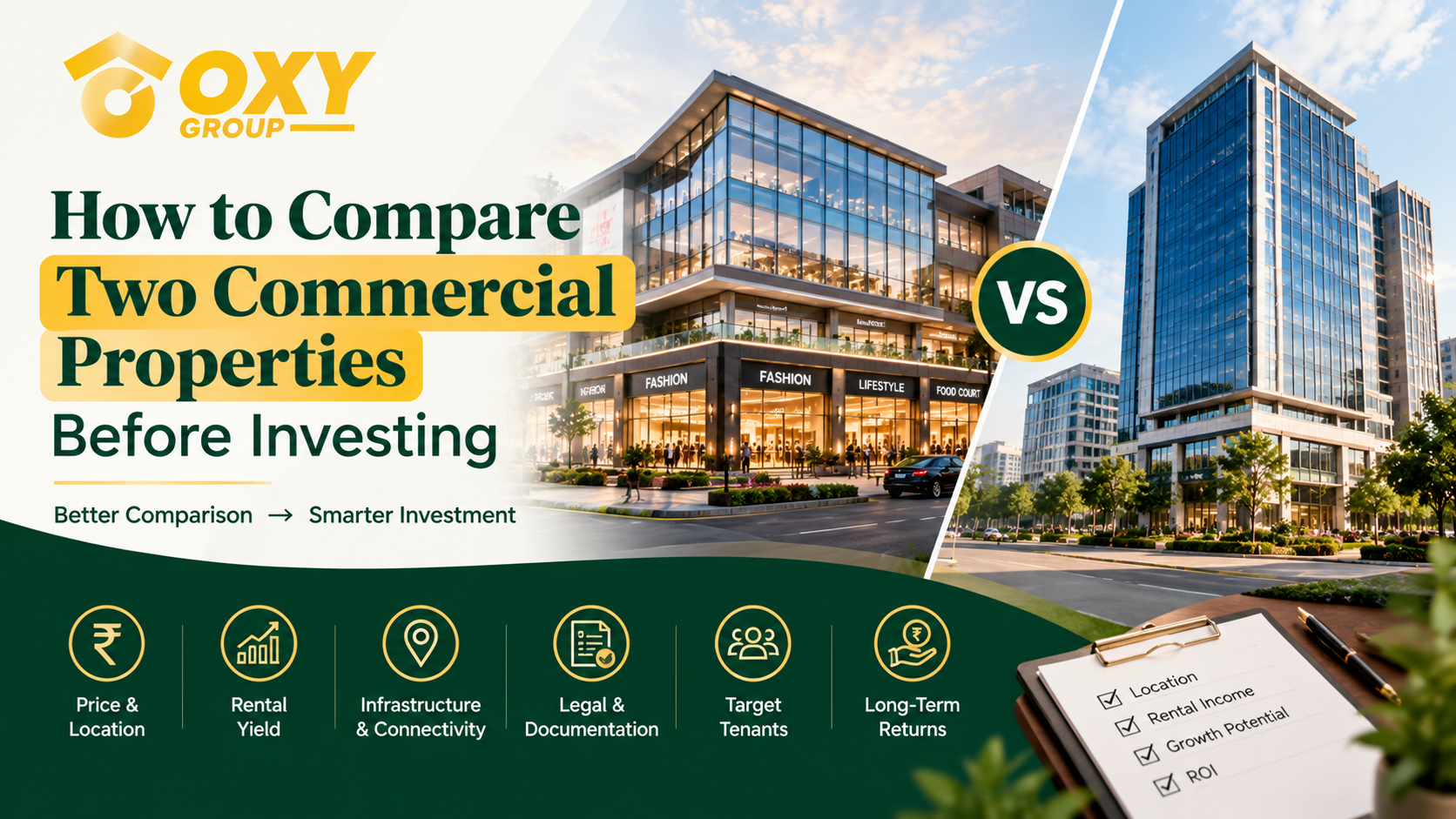
Investing in commercial real estate is a large financial decision. If you are planning to buy a retail shop, office space or a commercial unit in Ghaziabad, selecting the right property is more than simply comparing prices. You might think two properties look the same, but they can vary drastically in their rental income, location, maintenance costs, and future growth potential.
For instance, one commercial property may be cheaper, but it may be in an area with low customer traffic. Another might cost more but provide better connectivity and stronger rental demand. So how do you decide which is the better investment?
The trick is to compare the two properties with the same factors and not just the price. Here are the important things to check before buying a commercial property for all investors.
1. Location and Connectivity Comparison
In commercial real estate, location is one of the most important factors. A property in a good location can attract businesses, customers, and potential tenants more easily than a property in a less accessible area.
If comparing two commercial properties, ensure you verify the distance from main roads, highways, metro stations, residential societies and other commercial hubs. Also, think about whether people can easily get to the property by public transport or private vehicles.
For instance, a retail shop near a residential society may attract regular customers, while an office space near major roads and transport facilities may be more convenient for employees and clients.
If you are exploring commercial property in Ghaziabad, look at the area’s existing development, road connectivity, nearby residential population, and upcoming infrastructure. However, do not rely only on future development plans. Check whether the location already has the kind of activity your intended tenants or customers need.
What to compare:
- Connectivity to major roads and highways
- Availability of public transport
- Nearby residential and commercial areas
- Parking facilities and accessibility
- Existing business activity and footfall
A slightly more expensive property in a better location may offer stronger rental potential, but this depends on actual demand and the property’s overall costs.
2. Compare the Total Property Cost, Not Just the Price
One of the common mistakes buyers make is comparing properties only by their listed prices. The actual cost of purchasing a commercial property can include several additional charges and many more things.
Apart from the basic property price, you may need to pay stamp duty, registration charges, applicable taxes, maintenance deposits, parking charges, and other fees depending on the property and transaction.
For example, Property A may have a lower purchase price but higher maintenance charges and additional costs. Property B may initially seem expensive but have more manageable ongoing expenses.
Before making a decision, ask the seller or developer for a detailed cost breakdown. Make sure you understand what is included in the quoted price and what you will have to pay separately.
Compare these expenses:
- Basic property price
- Price per square foot
- Stamp duty and registration charges
- Maintenance and common area maintenance (CAM) charges
- Parking or other additional charges
- Interior, furnishing, or fit-out expenses, if applicable
Calculating the total investment will give you a clearer picture of which property fits your budget.
3. Analyse Rental Income and Return on Investment
If your main goal is to earn rental income, compare the expected rent from both properties before making a final decision.
A property with a higher purchase price does not automatically generate better returns. Similarly, a cheaper property is not always the more profitable option.
Start by checking the rental rates of similar commercial properties in the same area. Speak with local property consultants, review comparable listings, and understand the demand for that particular type of space.
You can use the following formula to calculate the gross rental yield:
Gross Rental Yield = (Annual Rental Income ÷ Total Property Cost) × 100
For example, suppose Property A costs ₹50 lakh and generates an annual rent of ₹3 lakh. Its gross rental yield is 6%.
Property B costs ₹60 lakh and generates an annual rent of ₹4.2 lakh. Its gross rental yield is 7%.
Based on these figures, Property B offers a higher gross rental yield.
Remember, these calculations are only examples. Actual rental income depends on the location, property condition, tenant demand, and market conditions.
4. Check the Property Type and Target Tenants
Not every commercial property serves the same purpose. A retail shop, office space, showroom, and commercial unit in a mixed-use development may attract different types of tenants.
Before comparing two properties, understand who is likely to rent or use each space.
For example, a shop in a busy retail area may be suitable for a clothing store, salon, or food outlet. An office space may be more attractive to consultants, agencies, or small businesses.
Consider whether the property’s size, layout, visibility, and facilities match the needs of potential tenants.
Ask yourself:
- What types of businesses can operate here?
- Is the space suitable for the intended business?
- Is there demand for this type of property in the area?
- Will the property appeal to multiple types of tenants?
- Are the layout and facilities practical for everyday use?
A property that meets the needs of a wider range of suitable tenants may give you more flexibility when renting it out. However, actual demand should always be verified.
5. Compare Amenities, Maintenance, and Building Quality
Amenities can influence how attractive a commercial property is to businesses and tenants. However, more amenities do not always mean a better investment.
Compare the facilities available in both properties and consider whether they are genuinely useful for the intended purpose.
Check for parking, lifts, security, power backup, washrooms, accessibility, common areas, and fire safety arrangements. For retail spaces, visibility and customer access may be particularly important. For office spaces, reliable utilities and convenient access may matter more.
You should also inspect the building’s overall condition. Look at the quality of construction, maintenance of common areas, water and electricity arrangements, and the management of the property.
6. Verify Legal Documents and Approvals
A property may look attractive and offer promising rental potential, but legal issues can create serious problems later.
Before investing in either property, verify the ownership documents and relevant approvals. The documents required may vary depending on the property, location, and type of transaction.
Important checks may include:
- Sale deed or title documents
- Encumbrance records, where applicable
- Approved building plans
- Occupancy or completion certificates, where applicable
- Applicable RERA registration details
- Property tax payment records
- Required permissions and no-objection certificates
If the property is already rented, review the lease agreement, rental terms, security deposit, lock-in period, and any existing disputes or obligations.
Common Mistakes to Avoid When Comparing Commercial Properties
Even after researching both options, buyers can overlook important details. Keep these common mistakes in mind:
- Choosing the cheapest property without checking its location and demand.
- Assuming the expected rent will always be received on time.
- Ignoring maintenance charges and other recurring expenses.
- Depending entirely on future development promises.
- Skipping legal verification to speed up the purchase.
- Investing without considering your budget and holding period.
A little extra research before buying can help you avoid expensive mistakes later.
Final Thoughts
Comparing two commercial properties before investing is about understanding which one offers the right balance of price, location, rental potential, and long-term suitability.
One property may be more affordable, while another may offer better connectivity or stronger tenant demand.
If you are exploring commercial property investment in Ghaziabad, take time to compare different locations, understand the total cost, check rental demand, and verify the necessary documents before making a decision.
At Oxy Infra, you can explore commercial property opportunities and compare options based on your requirements. Always evaluate the property’s actual features, costs, and location before deciding whether it suits your investment plans.
Frequently Asked Questions (FAQs)
1. How do I know which commercial property offers better returns?
Estimate the annual rental yield of both properties and account for expenses such as maintenance, taxes, repairs, and vacancy periods.
2. Is a cheaper commercial property always a better investment?
No. A cheaper property may have lower rental demand, poor connectivity, or higher maintenance costs. Compare the overall value rather than the purchase price alone.
3. Why is location important when investing in commercial property?
Location can affect customer access, tenant demand, rental income, and resale potential. The importance of each factor depends on the type of commercial property.
4. Should I check legal documents before buying commercial property?
Yes. Verify ownership, relevant approvals, tax records, and other applicable documents. A qualified property lawyer can help you identify potential legal issues.
5. Is Ghaziabad a good location for commercial property investment?
Ghaziabad offers a range of commercial property options, but suitability depends on the specific location, price, connectivity, tenant demand, and investment goals. Research the individual property before investing.